Reading English books with kids
When I first started reading English books with my kids, I thought the answer was pretty simple.
Read more books, and their English would naturally improve.
So I collected English books for kids, tried different reading programs, and kept looking for books that might be a good fit for them.
But after reading English books with my kids for years, I’ve realized that it isn’t really about how many books they read.
At least, that’s not the part that matters most to me anymore.
I’ve learned much more from watching which books my kids actually want to read.
How Reading English Books Helped My Kids
My kids don’t always like the books I choose.
This sounds obvious, but it took me a while to really accept it.
Sometimes I find a book and think,
“This looks great. They’ll love this.”
And then my kids have absolutely no interest in it. 😂
On the other hand, they sometimes pick a book that I would never have chosen for them.
And one of those books was Fly Guy.
Why My Son Loved Fly Guy
I remember seeing Fly Guy and thinking,
“Um… what is this?” 😂
A book about a fly?
I wasn’t sure why my son would be interested in it.
But my first child has always been interested in animals, bugs, and things that are a little bit unusual.
So maybe I shouldn’t have been surprised.
He actually loved Fly Guy.
What I found even more interesting was that he kept reading it again and again.
The language felt manageable for him, and the words were relatively easy for him to sound out and read on his own.
And I started noticing something I hadn’t really thought about before.
He seemed proud of himself when he could read the book by himself.
That was a big moment for me.
It wasn’t just that he was reading an English book.
He was realizing,
“I can read this myself.”
And I think that feeling can be incredibly motivating for a young reader.
Sometimes an Easy English Book Is Exactly What Kids Need
As parents, it’s easy to think that a book should be challenging to be useful.
We want our kids to learn new vocabulary.
We want them to read longer sentences.
We want them to move up to the next reading level.
I’ve definitely thought this way, too.
But watching my son read Fly Guy over and over made me rethink that.
If a book is a little easier, a child can read more of it independently.
They recognize familiar words.
They can follow the story.
And most importantly, they can experience the feeling of “I can do this.”
That feeling is hard to measure with a reading level or a vocabulary list, but I think it matters.
For me, this has become one of the most valuable parts of independent reading for kids.
Reading English Books Without Making It Feel Like Homework
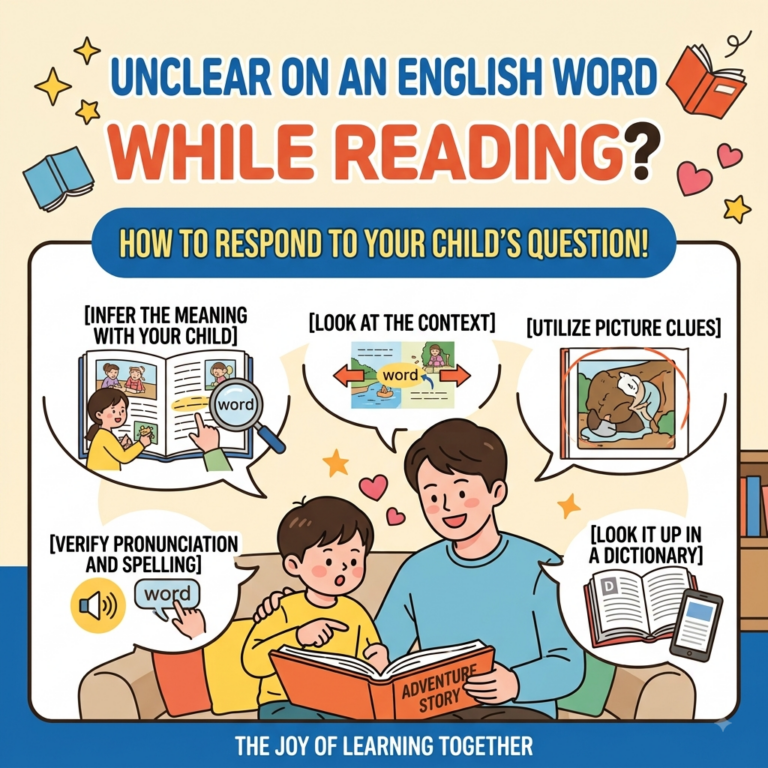
Another thing I’ve learned is that reading an English book and understanding every part of it are two different things.
A child can read a sentence without knowing every word.
They can understand the story from the pictures and the context.
Sometimes they know exactly what is happening even though they couldn’t explain every sentence.
I used to worry more about those little gaps.
Now, I try not to interrupt the story too much.
If I stop every few seconds to explain a word, the book starts feeling like homework.
And that’s not what I want.
I want kids reading in English to feel as natural as possible.
We Don’t Turn Every Book Into a Lesson
This is something I’ve become much more relaxed about.
Sometimes we read a book and that’s it.
No worksheet.
No vocabulary test.
No questions afterward.
Just the book.
Other times, if my kids are interested, I’ll ask a simple question.
“Which part did you like?”
“What happened here?”
“Why do you think he did that?”
Or I’ll point to a picture and let them tell me what they see.
I don’t need a perfect answer.
I’m just trying to keep the conversation going.
For us, English reading practice for kids doesn’t always have to look like studying.
Sometimes reading is enough.
One Sentence Can Be Enough
When we do want a little extra practice, I like using one sentence from the book.
Instead of making my kids memorize a whole list of vocabulary, we might play around with a simple sentence.
For example:
The boy runs to the park.
Then we might change one part.
The girl runs to the park.
Or:
The boy runs to the house.
It’s a very small activity, but it gives them a chance to notice how English sentences work.
And because the sentence came from a book they just read, it doesn’t feel completely disconnected from what they were doing.
This is one of the simplest ways I’ve found to make reading English books with kids a little more interactive without turning it into a formal lesson.
My Two Kids Have Taught Me to Be Flexible
Having two kids has made this even clearer to me.
They don’t learn in exactly the same way.
They don’t choose the same books.
They don’t have the same attention span.
And a book that works beautifully for one child might get ignored by the other.
So I’ve stopped looking for one perfect reading method.
Instead, I’m paying more attention to my kids.
What do they reach for?
What makes them laugh?
Which books do they read again?
Which books can they read independently?
And when do they seem genuinely proud of themselves?
Those things tell me much more than I expected.
What I Care About Now
I still want my kids to build strong English reading skills.
Of course I do.
But after all these years, I don’t think the answer is simply to give them harder books or make them read more.
I want them to have books they can enjoy.
Books they can understand.
And sometimes, books they can read all by themselves.
Watching my son pick up Fly Guy and read it again made me realize how important that little feeling of independence can be.
Maybe he wasn’t learning a huge number of new words every time he read it.
But he was practicing.
He was understanding the story.
He was enjoying himself.
And he was realizing that he could read an English book on his own.
For now, I’m pretty happy with that.
Because I think one of the best things we can give young readers is not just more books.
It’s the feeling that they can read them.