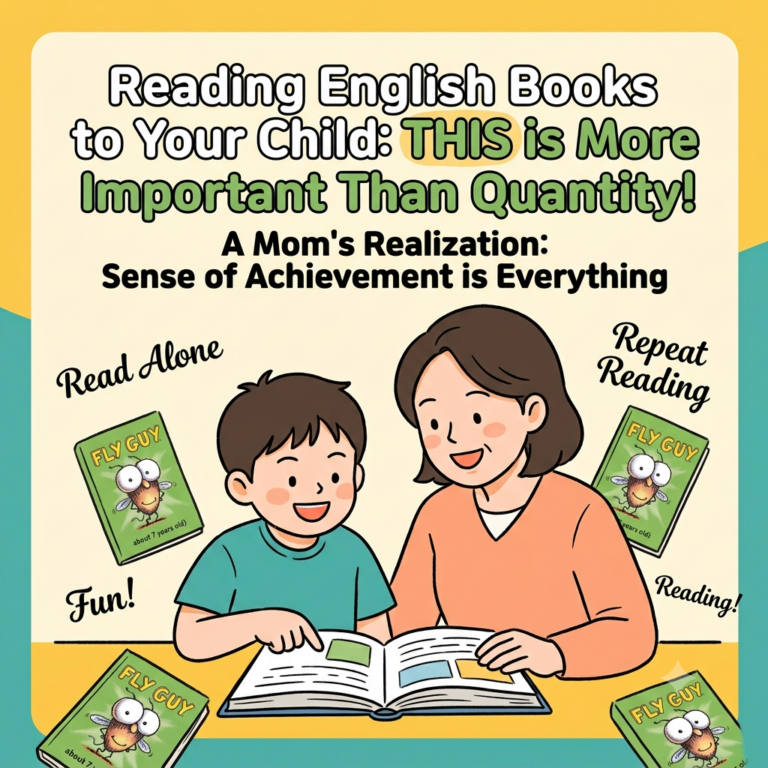
I thought reading English books with my kids would be pretty easy.
I mean, they’re children’s books, right?
How hard could they be?
Well…
I was wrong. 😂
I’m a mom in Korea, and English isn’t my first language. I’ve been reading English books with my kids for quite a while, and one thing surprised me more than I expected.
There are so many English words I don’t know.
Not complicated words from a textbook.
Just everyday words that somehow never came up in my own English.
Animals.
Insects.
Plants.
Things in nature.
Little action words.
I’d be reading along just fine, and then suddenly I’d stop and think,
Wait… what does that word mean?
And then, of course, my child would ask the worst possible question at exactly the right moment.
“Mom, what does this mean?”
😂
What If I Don’t Know the Word Either?
This used to make me feel a little embarrassed.
I thought I was supposed to know the answer because I was the one reading the book.
But I’ve gotten much more comfortable saying:
“I don’t know this word either. Let’s figure it out.”
Usually, we look at the picture first.
Then we look at the sentence and the words around it.
Sometimes the meaning becomes pretty obvious from the story.
And sometimes it doesn’t.
That’s okay, too.
If I really need to know the meaning, I’ll look it up later.
I don’t think I need to stop the entire story every time we come across an unfamiliar word.
Actually, if we stopped for every word I didn’t know, we’d probably never finish the book. 😂
Should I Explain the Word in English or Korean?
This is something I’ve wondered about a lot.
When my kids ask me what an English word means, I usually explain it in Korean.
And honestly, I don’t think that’s a bad thing.
If my child is asking because they genuinely don’t understand what’s happening in the story, I want to make sure they understand the story first.
For example, if there’s a word that’s important to the plot, I’ll just explain it simply in Korean and keep going.
But if it’s an easy word to explain in English, I’ll sometimes use English instead.
For example:
“Tiny means very, very small.”
That’s usually enough.
I don’t need to give my child a dictionary definition.
And I don’t think every word needs to become a vocabulary lesson.
Sometimes the picture is enough.
Sometimes the context is enough.
Sometimes we can just keep reading.
The goal is still to enjoy the book.
Do I Need to Look Up Every Unfamiliar Word?
No.
At least, I don’t.
When I first started reading more English books with my kids, I felt like I should know every word.
Now I’ve realized that it’s actually okay to let some words go.
If the word isn’t important to the story, we can keep reading.
If it keeps appearing, seems important, or my child is especially curious about it, then I’ll make a note of it and look it up later.
This also keeps reading from turning into a vocabulary test.
And that’s important to me.
I want my kids to associate English books with stories, characters, and fun.
Not with stopping every two minutes to memorize words.
Reading English Books Has Been Good for Me, Too
This is probably the part I didn’t expect.
I originally started reading English books with my kids because I wanted them to become comfortable with English.
But somewhere along the way, I realized that I’m learning, too.
My kids have introduced me to so many words I probably wouldn’t have learned from everyday conversations.
Sometimes they ask about a word I’ve never seen before.
Sometimes I find myself wondering about a word while I’m reading.
And sometimes we figure it out together.
I used to think I needed to be the person who already knew all the answers.
Now I’m much more comfortable saying,
“I don’t know. Let’s find out.”
Maybe that’s one of the best things about learning with kids.
You don’t have to know everything before you start.
Sometimes, you can just learn together.