Many foreigners are surprised when they hear about Korean kindergarten culture, but one thing that often shocks them the most is how many things Korean parents prepare for kindergarten.
For Korean parents, it feels completely normal. But when I stop and think about it, it really is a lot sometimes 😂
When a new semester starts, kindergartens usually send out a long preparation notice for parents.
Basic personal items are common:
indoor shoes, a toothbrush, a cup for brushing teeth, towels, extra clothes, and sometimes spare socks or underwear.
But that is only the beginning.

At the start of the semester, many Korean kindergartens also ask families to bring supplies such as wet wipes, tissue boxes, and even baby wipes for bathroom use.
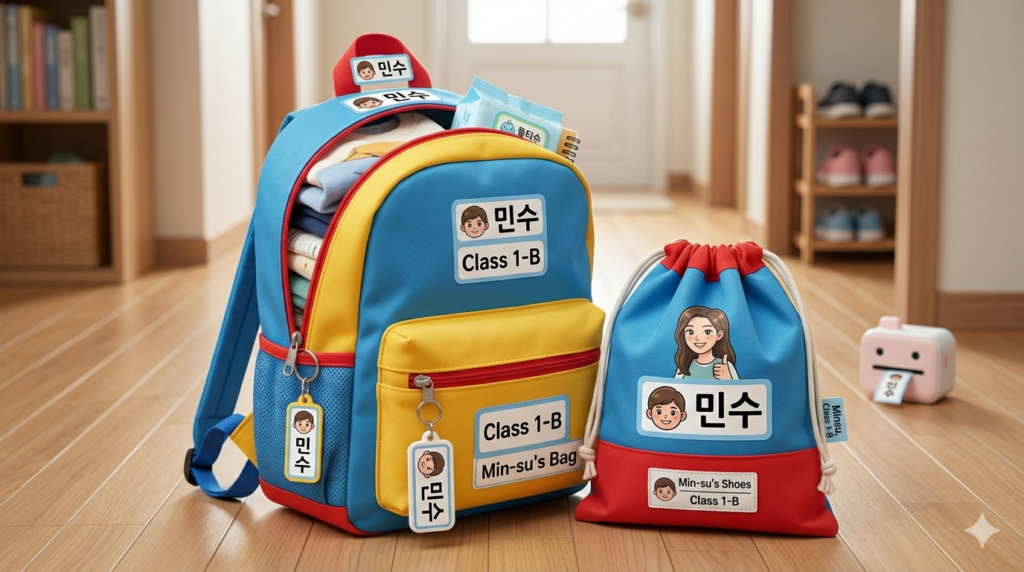
And every single item needs the child’s name and class written on it.
The wipes need labels.
The toothbrush needs a label.
The cup needs a label.
Even the towel needs a label.
Because of this, name sticker machines are surprisingly popular in Korea among parents with young children.
Some parents buy machines and print labels at home, while others order large sets of cute customized name stickers with cartoon characters through group purchases with other moms.
I still use name stickers that I ordered years ago when my oldest child first started daycare. Honestly, they ended up being one of the most useful parenting purchases 😂
Foreign friends are usually surprised by this part because not every country has such a strong “label everything” culture for children’s belongings.
But in Korea, children’s items are often very similar, and kids spend so much time together in group settings that things get mixed up very easily.
It is also common for Korean parents and teachers to pay close attention to hygiene and organization, so labeling everything has become part of everyday kindergarten life.
One interesting thing is that many Korean kindergartens actually share classroom supplies together.
Items like markers, crayons, scissors, glue sticks, and colored pencils are often used communally in the classroom instead of being individually prepared by each child.
But once children enter elementary school, things become much more serious 😅
At that point, children usually need to prepare their own stationery sets, and parents often put name stickers on every single item.
Not just the box.
Not just the pencil case.
The actual markers and colored pencils themselves.
And yes… sometimes even both the cap and the pen body separately 😂
Some very detail-oriented parents even cover the stickers with transparent tape so the labels will not peel off during the school year.
Another important part of Korean kindergarten culture is extra clothing.
Most parents send spare clothes based on the season, including underwear and socks.
Young children spill drinks, get wet during outdoor activities, fall into puddles, or sometimes have bathroom accidents unexpectedly.
There are honestly a lot of unpredictable situations when small children spend an entire day together.
So Korean parents often update extra clothing throughout the year whenever the weather changes.
During summer, lighter clothes are added.
During rainy season, extra socks might be packed.
During colder months, warmer layers are prepared.
And then there is the kindergarten communication app culture.
Many Korean kindergartens no longer use paper communication notebooks every day. Instead, parents use apps such as 키즈노트 to communicate with teachers and receive updates.
Parents check these apps constantly.
The app is not only used for announcements or reminders about supplies.
Teachers also upload photos from the children’s daily activities, so parents can see what happened during the day.
Sometimes there are photos from art activities, outdoor playtime, cooking classes, science activities, or seasonal events.
For many parents, checking these photos becomes part of the daily routine.
Lunch information is also shared regularly.
Most kindergartens provide monthly meal plans, but many teachers also upload a sample tray photo showing the food served that day.
Parents often look at the picture and think things like:
“Oh, my child probably liked this menu.”
“Looks healthier than what I made at home today 😂”
The apps are also used when parents need to send messages to the kindergarten.
For example:
- reporting a late arrival
- explaining that the child is not feeling well
- changing pickup times
- sharing health-related information
One system that foreign parents often find especially interesting is the medication request process.
If a child needs medicine during kindergarten hours, parents cannot simply send the medicine in the bag.
They usually need to fill out a medication request form inside the app first.
Parents must write details such as:
- what medicine it is
- when it should be given
- how much should be administered
Only after that can the teachers give the medication.
At first, this system felt very detailed to me too, but it also reflects how carefully Korean kindergartens manage children’s safety and daily routines.
Looking at all of this together, Korean kindergarten culture feels very organized, detailed, and preparation-heavy compared to many other countries.
Sometimes it can honestly feel overwhelming as a parent.
There are days when I suddenly check the app late at night and realize:
“Tomorrow we need to bring special materials for an activity…” 😂
But at the same time, I think this culture also reflects how much attention Korean parents and teachers give to children’s daily life, comfort, and group activities.
And once you become used to it, labeling wipes at midnight somehow starts to feel completely normal too.