Understanding Korea’s “Family Month” Culture
If you visit Korea in May, you might notice something interesting very quickly.
Flower shops become crowded.
Theme parks fill with families.
Children carry carnations home from school.
Parents suddenly start searching for gifts, restaurant reservations, and family outing ideas.
That is because May in Korea is known as “Family Month” (가정의 달).
Several important celebrations happen within just a few weeks, and many of them are connected to family, gratitude, children, and teachers. For Korean families, May is often one of the busiest months of the year emotionally, socially, and financially.
Some people even joke that May is:
“the warmest month for the heart and the hardest month for the wallet.”
Honestly, many Korean parents probably agree.
Why Koreans Call May “Family Month”
Unlike some countries where family-related holidays are spread throughout the year, Korea has many of them concentrated in May.
The month includes:
- Labor Day
- Children’s Day
- Parents’ Day
- Teachers’ Day
- Buddha’s Birthday
Because these celebrations happen so close together, May naturally became associated with family gatherings, appreciation, gift-giving, and spending time together.
For families with young children especially, the schedule can become surprisingly full.
School events, kindergarten performances, children’s festivals, family dinners, flower purchases, and weekend outings often all happen within the same month.
May 1: Labor Day in Korea

Labor Day (근로자의 날) is celebrated on May 1.
Although it is not considered an official national holiday for everyone, many office workers receive the day off. Parents sometimes use the extra day to spend time with their children or plan short family outings.
As a result, cafes, shopping malls, parks, indoor playgrounds, and popular family attractions can become much busier than usual.
For many families, May starts with the feeling that “holiday season” has officially begun.
May 5: Children’s Day Is a Huge Event in Korea

Children’s Day (어린이날) is one of the biggest celebrations of the month.
In Korea, this is not treated like a small symbolic holiday. It is a major family event.
Theme parks, zoos, museums, festivals, aquariums, and playgrounds become packed with families. Many parents prepare weeks in advance because traffic and crowds can become intense on Children’s Day weekend.
Children often receive gifts, toys, books, or special experiences. Some families travel, while others simply spend the entire day together.
For young children, the atmosphere can feel almost similar to Christmas.
Interestingly, while some countries have holidays related to children, Korea celebrates Children’s Day on a particularly large scale. The holiday reflects how strongly Korean society values education, childhood experiences, and family involvement.
For parents, however, the holiday can also feel exhausting.
Between outing costs, admission tickets, meals, transportation, and gifts, Children’s Day alone can become expensive very quickly.
May 8: Parents’ Day in Korea


Instead of celebrating Mother’s Day and Father’s Day separately, Korea combines both into Parents’ Day (어버이날).
Carnations become one of the most recognizable symbols of May in Korea. Schools, grocery stores, flower shops, and even convenience stores display carnations everywhere during this period.
Young children often prepare handmade cards or carnations at school. Adult children may buy flowers, meals, health products, or small gifts for their parents.
For many Koreans, Parents’ Day becomes more meaningful with age.
As people get older and become parents themselves, they often begin to understand their own parents differently. The holiday can feel emotional because it encourages families to openly express appreciation — something that is not always done regularly in everyday Korean culture.
At the same time, it also adds another financial event into an already expensive month.
Many parents joke that May becomes a nonstop cycle of:
flowers, gifts, family dinners, and online shopping carts.
May 15: Teachers’ Day Reflects Korea’s Education Culture

Teachers’ Day (스승의 날) is another uniquely important celebration in Korea.
Education has a very strong cultural importance in Korean society, and teachers are traditionally viewed with deep respect.
Students often write handwritten letters or prepare thank-you messages for teachers. Younger children may create crafts or cards in kindergarten and elementary school.
In the past, gift-giving for teachers was more common. Today, however, Korea has stricter regulations regarding gifts for public educators, so the culture has shifted more toward sincere letters and expressions of gratitude instead.
Still, many parents continue thinking carefully about how to thank teachers politely and appropriately.
Teachers’ Day also highlights something interesting about Korean culture:
relationships between parents, teachers, and schools tend to be very involved and emotionally significant.
Buddha’s Birthday Adds Another Holiday to the Month
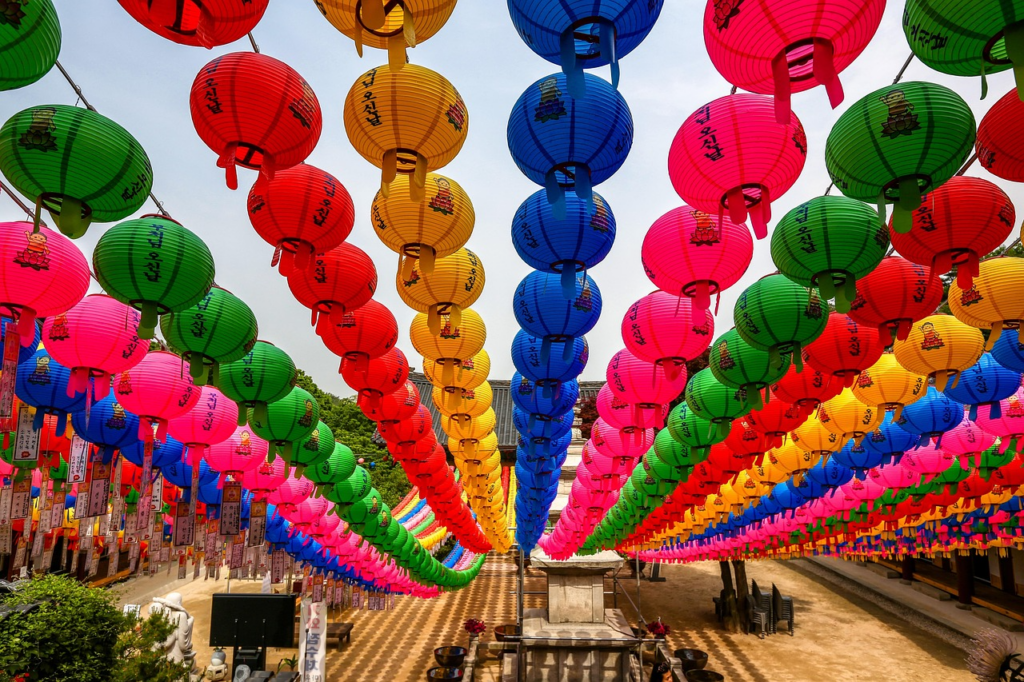
Buddha’s Birthday (부처님오신날) is also a national holiday in Korea.
During this time, temples across the country decorate with colorful lanterns, and many cities hold lantern festivals or cultural events.
Even people who are not Buddhist often visit temples during May because the lantern displays are beautiful and the atmosphere feels peaceful.
For foreign visitors, this can be one of the most visually memorable periods to experience Korean culture.
At night, streets near major temples glow with lanterns in many different colors, creating a very unique atmosphere that feels completely different from the rest of the year.
Why May Can Feel Financially Stressful for Korean Families
One reason many Korean parents laugh about May is simple:
everything happens at once.
Within just a few weeks, families may spend money on:
- Children’s Day gifts
- family outings
- theme park tickets
- flowers
- Parents’ Day meals
- school events
- thank-you gifts
- travel
- dining out
Families with multiple children especially can feel the pressure.
Parents often joke online that:
“May is the month where your savings disappear.”
Of course, most people still enjoy the celebrations. But there is definitely a shared feeling that May requires extra budgeting.
A Month That Represents Korean Family Culture
What makes May in Korea especially interesting is that the celebrations are not only about holidays.
They reflect important values in Korean culture:
- respect for parents
- appreciation for teachers
- strong family involvement
- celebrating children
- spending time together
That is why many Koreans naturally refer to May as “Family Month.”
It can be crowded, expensive, emotional, and exhausting at times.
But it is also one of the warmest and most meaningful months of the year for many families in Korea.