In South Korea, many students attend hagwons, private academies that provide extra education after regular school hours. hagwon korea!
What Is Hagwon Culture in Korea?
South Korea is well known for its strong emphasis on education. One of the most unique parts of the Korean education system is something called “hagwon culture.”
If you visit Korea, it is very common to see children going to private academies after school. In many neighborhoods, entire streets are filled with hagwon buildings offering classes in everything from math and English to music, art, and even coding.
For many Korean families, attending hagwons is simply a normal part of daily life.
But what exactly is a hagwon, and why do so many Korean students attend them?
This article explains what hagwon culture is, why it exists, and how it shapes the daily lives of Korean children.
What Is a Hagwon?
A hagwon (학원) is a private educational academy where students study outside of regular school hours.
Originally, hagwons were designed to help students supplement their public school education. Students could review lessons they learned in school, receive extra tutoring, or get help with difficult subjects.
However, over time hagwons have become much more than simple tutoring centers. Today, they play a major role in Korea’s education system.
Many students attend multiple hagwons every week, and some spend several hours each day studying in these academies.
Because of this, hagwons are often considered an essential part of Korean education.
Why Are Hagwons So Common in Korea?

One of the biggest reasons hagwons are so common in Korea is the country’s highly competitive education environment.
Many parents believe that additional education outside of school can give their children better opportunities in the future. Entering a good university is often seen as an important step toward career success.
Because of this belief, parents often invest significant time and money in their children’s education.
In Korea, there are even popular phrases that reflect this competitive culture: “the 4-year-old exam” and “the 7-year-old exam.”
These are not official exams, but they describe the intense preparation some parents begin when their children are very young.
- The “4-year-old exam” refers to the competitive process of entering prestigious English kindergartens. Some parents prepare their children for interviews or language exposure programs even before kindergarten.
- The “7-year-old exam” refers to preparation for selective elementary schools or advanced educational programs.
These phrases illustrate how early educational competition can begin in Korean society.
Why Do Korean Children Go to Hagwons?
Many Korean children grow up in an environment where education is highly valued.
Parents often pay close attention to developmental milestones. For example, parents may talk about which baby starts walking earlier or which child begins speaking sooner.
As children grow older, this attention gradually shifts toward learning and academic development.
Because of this cultural emphasis on education, many educational programs exist even for very young children.
Some companies offer home visiting lessons for babies under one year old. These programs usually focus on activities such as sensory play, music, art, or language exposure.
Even though these are not traditional academic subjects, the idea of educational programs for babies can surprise people from other countries.
Interestingly, some of these programs are quite popular, and parents may even need to join waiting lists to enroll.
Even for parents living in Korea, this level of early education can sometimes feel surprising or humorous.
When Do Korean Children Start Going to Hagwons?

Many children begin attending hagwons around age three or four, when they start kindergarten.
Some of the most common hagwons for young children include:
- Taekwondo academies
- English hagwons
- Art academies
- Piano lessons
In addition to these, there are many other types of academies such as:
- Swimming classes
- Ballet academies
- Science academies
- Coding classes
The variety of hagwons in Korea is extremely wide.
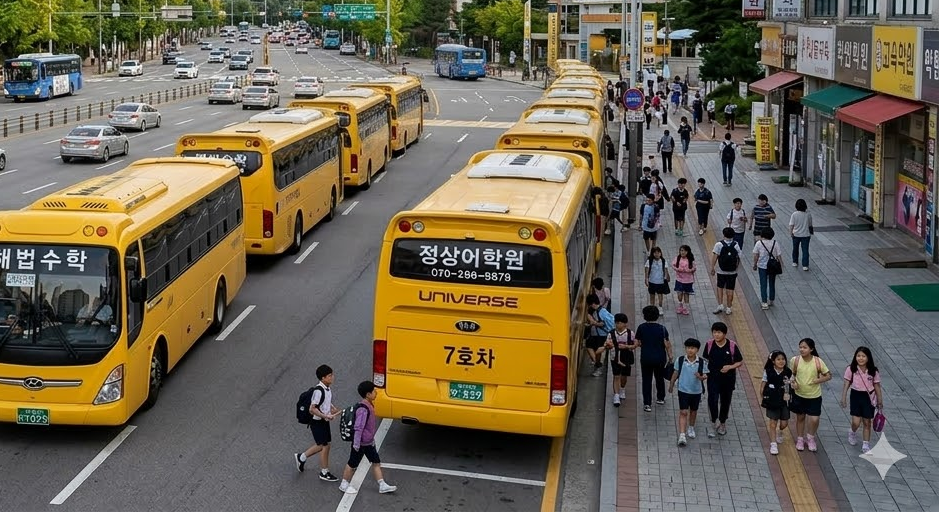
One unique feature of hagwon culture is the shuttle bus system. When kindergarten or school ends, many hagwon buses arrive directly at the school to pick up students.
For working parents, this system is very convenient. Children can move directly from school to their hagwon without their parents needing to pick them up.
Even children attending English kindergartens, which already focus heavily on language learning, often attend additional hagwons afterward.
Among physical activities, Taekwondo academies are especially popular, and many children attend them regularly.
What Do Students Learn at Hagwons?
Hagwons offer an incredibly wide range of subjects and activities.
Some focus on academic learning, such as:
- Mathematics
- English
- Science
Others focus on physical activities, including:
- Taekwondo
- Swimming
There are also many academies that focus on creative or artistic education, such as:
- Piano
- Ballet
- Art classes
Because each hagwon usually specializes in one subject, many children attend more than one academy.
This allows students to explore different interests while also strengthening academic skills.
A Typical Day for Korean Children
The daily schedule for many Korean students can be quite busy.
After finishing school or kindergarten, children often go directly to a hagwon. Many students attend classes until around 4 PM to 6 PM.
Since many academies operate shuttle buses, children are often transported directly from their school to the academy.
Some hagwons even provide snacks between classes, although this is usually included as an additional fee.
After returning home, students may still need to complete homework from school or their hagwon classes. By the time they finish everything, it is often close to bedtime.
For young children, this can be a long and demanding day.
How Much Do Hagwons Cost?
Hagwon tuition can vary depending on the subject and the location.
For kindergarten-age children, many parents pay approximately 200,000 to 300,000 Korean won per subject per month.
Some academies meet once or twice per week, while others meet three times per week.
Taekwondo academies are often considered one of the more affordable options. Some children attend up to five times per week, which can make it a relatively cost-effective activity.
However, since many children attend multiple hagwons, the total cost of private education can become quite high.
For some working parents, hagwons also help fill the time between school hours and parents’ work schedules.
Pros and Cons of Hagwon Culture
Like many educational systems, hagwon culture has both advantages and disadvantages.
Advantages
Hagwons can provide additional academic support and help students strengthen their skills in specific subjects.
They also allow children to explore a wide variety of interests, such as music, art, sports, or coding.
In some cases, smaller class sizes allow for more individualized instruction.
Disadvantages
However, attending multiple hagwons can lead to very long daily schedules.
Some children leave home at 9 AM for school and do not return until 6 PM or later.
For middle school students, it is not uncommon to stay at academies until 9 PM or even 10 PM.
Because of these long study hours, hagwon culture is often criticized for placing too much pressure on students.
The Debate Around Private Education in Korea
In Korean society, the role of private education is often debated.
Many people worry that heavy reliance on hagwons can increase educational inequality and place too much pressure on children.
This issue has even been portrayed in Korean popular culture.
One famous example is the Korean drama “Sky Castle.” The series critically depicts the extreme competition among wealthy families trying to send their children to top universities such as Seoul National University’s medical school.
The drama became very popular because it reflected real concerns within Korean society about academic pressure and parental expectations.
A Real Daily Schedule of Korean Students
To better understand hagwon culture, it helps to look at what a typical weekday can look like for a Korean student.
While schedules vary depending on age and family preferences, many students follow a routine similar to this.
Example schedule for an elementary school student:
8:30 AM – Arrive at school
9:00 AM – 2:30 PM – Regular school classes
3:00 PM – Hagwon shuttle bus pickup
3:30 PM – 4:30 PM – Math hagwon
5:00 PM – 6:00 PM – English hagwon
6:30 PM – Return home
7:00 PM – Dinner
8:00 PM – Homework or review study
9:30 PM – 10:00 PM – Bedtime
For younger children in kindergarten, the schedule can be slightly shorter. However, many still attend at least one or two hagwons after school.
As students grow older, the schedule often becomes even more intense.
Middle school and high school students may stay at academies until 9 PM, 10 PM, or even later, especially when preparing for important exams.
Because of this demanding schedule, hagwon culture is often discussed both positively and critically in Korea.
Some people believe it helps students achieve academic success, while others worry that it creates too much pressure at a young age.
Conclusion
Hagwon culture is one of the most distinctive aspects of the Korean education system.
For many Korean families, hagwons are not simply optional tutoring centers. They are an important part of daily life and education.
While opinions about hagwon culture vary, it clearly reflects Korea’s strong emphasis on education and the desire of many parents to provide the best possible opportunities for their children.
Understanding hagwon culture offers valuable insight into both the strengths and challenges of Korea’s education system.