If you are visiting Korea in September, you may hear the word Chuseok quite a lot.
Chuseok is one of the biggest traditional holidays in Korea. It is often compared to Thanksgiving because families get together, share a big meal, and spend time together.
But Chuseok is more than just a Korean Thanksgiving.
It has its own traditions, many of which are connected to the harvest, family, and remembering ancestors.
And while some of these traditions are still practiced today, Chuseok in modern Korea looks quite different from how it did in the past.
What Is Chuseok?
Chuseok is a traditional Korean holiday celebrated on the 15th day of the eighth month of the lunar calendar.
Because Korea follows the lunar calendar for traditional holidays, the date changes every year on the Western calendar.
In 2026, Chuseok falls on September 25.
Chuseok is also a three-day public holiday in Korea. The day before and the day after Chuseok are public holidays as well.
The holiday comes at the time of year when the main harvest is approaching, so traditionally it was a time to be thankful for the year’s crops and enjoy the food that had been prepared.
For many Koreans, though, the most important part of Chuseok today is much simpler:
getting together with family.
What Did Koreans Traditionally Do During Chuseok?
Chuseok used to be a much more hands-on family holiday.
There was a lot of food to prepare, relatives to visit, and traditional customs to follow.
One of the best-known traditions is charye, a memorial ceremony for ancestors.
Families prepared food and placed it on a table before paying their respects to their ancestors.
Another important tradition was visiting family graves.
But there was actually something that often happened before the visit.
Beolcho: Taking Care of the Family Grave
You may come across the word beolcho (벌초) when learning about Chuseok.
Beolcho means cutting away grass and weeds around a family grave and keeping the area tidy.
This tradition makes sense when you look at traditional Korean burial culture.
For a long time, burying family members in graves was a common practice in Korea. Many families had ancestral graves on hills or in the countryside, and these graves needed to be maintained.
So before Chuseok, family members would often visit the graves, cut the grass, and clean up the area.
After that, they might return during Chuseok for seongmyo (성묘), which means visiting an ancestral grave to pay respects.
Today, cremation has become much more common in Korea, so not every family has a traditional family grave anymore.
Still, beolcho and seongmyo remain familiar parts of Chuseok culture, especially for families who continue these traditions.
Songpyeon and Chuseok Food
Food is a huge part of Chuseok.
The most famous Chuseok food is probably songpyeon (송편).
Songpyeon is a small rice cake made from rice flour and filled with ingredients such as sesame seeds, beans, or chestnuts. It is traditionally steamed over pine needles, which give the rice cakes a subtle aroma.
Making songpyeon was also a family activity.
Children could sit around the table with their parents or grandparents, shape the rice cakes, and inevitably make a few that looked nothing like the others.
That kind of ordinary family moment was part of the holiday, too.
Other foods commonly associated with Chuseok include jeon, various pan-fried dishes, japchae, grilled or braised meat, fresh fruit, and other homemade foods prepared for the family gathering.
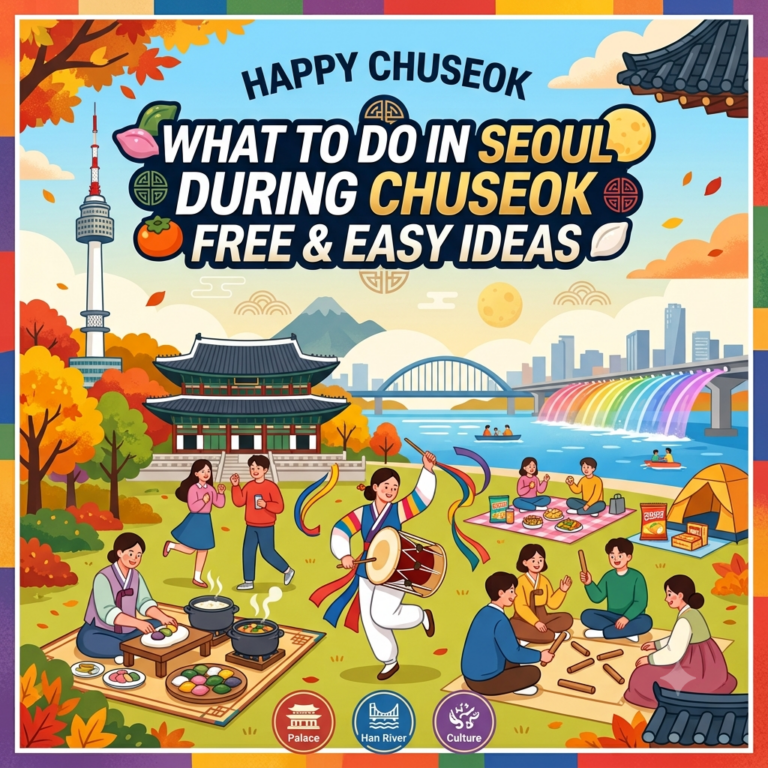
If you are wondering what you can actually do in Seoul during Chuseok, check out our guide to What to Do in Seoul During Chuseok.
Traditional Chuseok Games
Chuseok was not only about food and ceremonies.
Families also enjoyed traditional games together.
Some examples include:
- Yut nori (윷놀이) – a traditional board game using four wooden sticks
- Jegichagi (제기차기) – kicking a small shuttlecock-like object
- Tuho (투호) – throwing arrows into a container
- Ganggangsullae (강강술래) – a traditional circle dance traditionally performed by women
You can still see these games at museums, cultural centers, and Chuseok festivals today.
And honestly, for children, these are often some of the most fun parts.
But Chuseok Has Changed
This is probably one of the most interesting things about Chuseok today.
Many of the traditions above are still familiar to Koreans, but they are no longer something every family practices at home.
In the past, children might have naturally watched their grandparents prepare holiday food, helped make songpyeon, visited family graves, and spent several days surrounded by relatives.
Today, family life looks very different.
Some families still prepare a large meal and hold charye.
Some have simplified the ceremony.
Some families do not hold charye at all and simply have a meal together.
And some people use the holiday to rest, take a domestic trip, or travel abroad.
There is no single way that every Korean family celebrates Chuseok anymore.
Chuseok Culture Outside the Home
For children growing up in Korea today, some traditional Chuseok customs are becoming something they experience outside the home.
Instead of learning everything from grandparents or participating in a family ceremony, children might learn about Chuseok at a museum, a cultural center, or a special holiday event.
During the Chuseok season, many museums and cultural spaces offer hands-on programs where children can make songpyeon, play traditional games, try traditional crafts, or learn about old Korean customs.
As a parent, I find this change quite interesting.
Some things that were once simply part of everyday family life are now things we sometimes have to make an effort to experience.
It is not necessarily a bad thing.
Culture changes as people’s lives change.
But if you want your children to experience traditional Chuseok culture today, visiting a museum or joining a cultural program can actually be one of the easiest ways to do it.
What Does Chuseok Mean to Koreans Today?
For many Korean families, Chuseok is no longer about following every traditional custom exactly as previous generations did.
It is often much simpler.
Come home.
Eat together.
See your parents and grandparents.
Talk.
Rest.
And spend a little more time together than you normally would.
Some families travel for the holiday, some stay home, and some continue many of the old traditions.
Others have changed almost everything except the idea of getting together.
I think that is what makes Chuseok interesting.
The traditions are changing, but the reason for the holiday still feels quite familiar.
It is a time to slow down, remember family, and spend time together.
And if you are visiting Korea during Chuseok and want to experience some of these traditions yourself, you do not necessarily need to join a Korean family’s holiday.
Museums, cultural centers, and traditional festivals around Seoul often offer a chance to see and experience these customs up close.
For ideas on what you can actually do in Seoul during the holiday, check out our guide to What to Do in Seoul During Chuseok.