I Grew Up in Korea’s Test-Focused Education System — And It Changed How I Think About Parenting
I grew up in a generation where tests, correct answers, and grades carried enormous weight.
School life revolved around exams.
Getting the right answer mattered.
Good scores mattered.
And in many ways, academic performance shaped how students saw themselves.
Teachers also held strong authority.
Questioning a teacher was uncommon.
Not necessarily because teachers were unfair or wrong, but because asking “Why?” often felt unfamiliar — sometimes even inappropriate.
Looking back, I sometimes joke about it like this:
If a teacher pointed at something red and said, “This is black,” many of us would probably have accepted it and thought, Oh… it must be black then.
Of course, that is an exaggeration.
But it captures the atmosphere many students experienced at the time.
Teachers were strict.
Today’s conversations about student rights, school violence, or classroom authority looked very different back then.
If a teacher told us to do something, we did it.
If they told us not to, we stopped.
That was simply normal for us.
Growing Up With Structure and Discipline
I do not look back on my education with resentment.
There were strengths in that system too.
We learned discipline.
We studied consistently and developed strong work habits.
Basic academic foundations mattered, and effort was expected.
When it came to absorbing information, memorizing concepts, and producing results under pressure, the system was remarkably effective.
Input and output.
Study and perform.
For building academic basics and strong study habits, it worked.
And I think many people from my generation would agree with that.
Education was highly valued.
Competition was normal.
And honestly, we were busy.
Private Education Was Part of Everyday Life
Private education was not unusual.
It was simply part of life.
After school, many students headed straight to tutoring sessions or private academies, known in Korea as hagwon.
Math.
English.
Science.
Sometimes several in one day.
Looking back, I realize how little free time many students had.
I remember watching American teen dramas when I was younger and noticing something that felt strangely different.
Students joined cheerleading teams.
Played football.
Participated in music or theater.
Had hobbies and extracurricular activities that seemed to be part of ordinary teenage life.
Of course, television is not reality.
But compared to what I experienced, it still felt unfamiliar.
During my middle and high school years, unless someone planned to major in the arts or sports professionally, extracurricular activities were uncommon.
Having art, music, or sports simply as a hobby often felt like a luxury.
The atmosphere was closer to this:
Why spend time on that?
Take another academy class instead.
Study a little more.
Improve your scores.
That mindset was not necessarily cruel.
It came from a place of hope, expectation, and deep belief in education.
Parents wanted opportunities for their children.
Teachers wanted students to succeed.
And students learned to keep moving forward.
Where Things Became More Complicated
The challenges became more visible later.
For many students, university brought an unexpected difficulty:
choice.
Choosing courses.
Planning schedules.
Managing credits.
Deciding what to study and why.
And surprisingly, that part often felt harder than exams themselves.
We had spent years learning how to follow a path, but not always how to design one ourselves.
I remember feeling something similar again after entering the workforce.
School had trained us to find correct answers.
But work asked different questions.
“What do you think?”
“What approach would you suggest?”
“How would you solve this?”
At first, those questions felt uncomfortable.
Not because we lacked ability.
But because expressing personal opinions was a different skill from choosing the correct answer.
And unlike school tests, adulthood rarely comes with four options to select from.
There is often no answer sheet.
Only decisions.
Becoming a Parent Changed My Perspective
This is probably why becoming a parent made me think more deeply about education.
I still value discipline.
I still believe academic foundations matter.
And I do not think everything about my generation’s education was wrong.
But parenting has made me ask new questions.
What kind of learner do I hope my child becomes?
Of course I want my children to study well.
But beyond scores, I find myself hoping for something else too.
I hope they can think freely.
I hope they can express their own opinions without fear.
And perhaps most importantly, I hope they can understand that their opinions and other people’s opinions do not always have to match.
Disagreement does not have to feel threatening.
Different ideas can exist together.
Maybe this is why I became curious about discussion-based and question-centered learning.
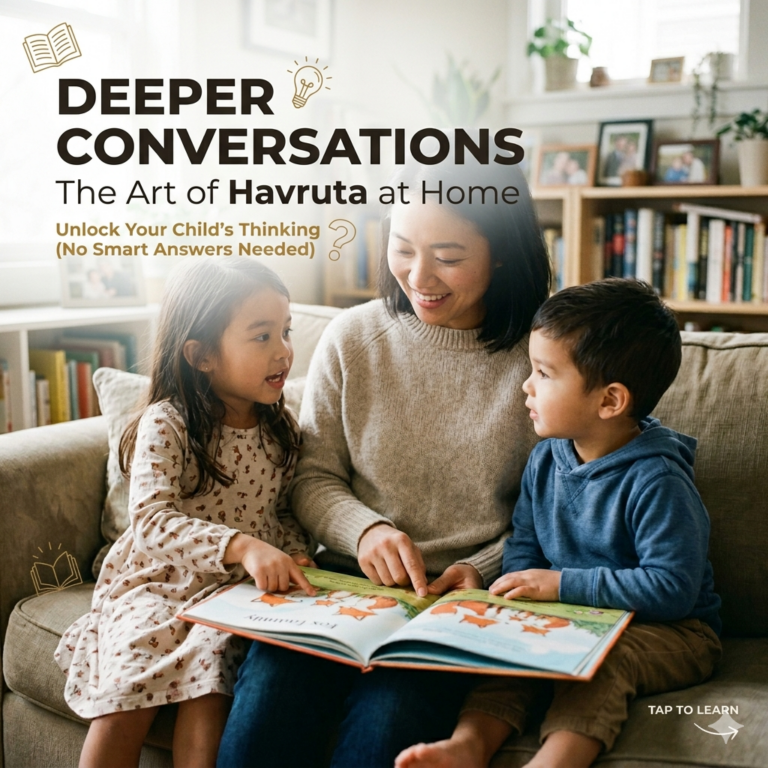
Recently, I started reading about Havruta, a Jewish learning tradition centered around dialogue and questioning.
And interestingly, it made me realize something:
Perhaps education is not only about finding answers.
Maybe it is also about learning how to ask better questions.